
Talk to your operation. Out loud
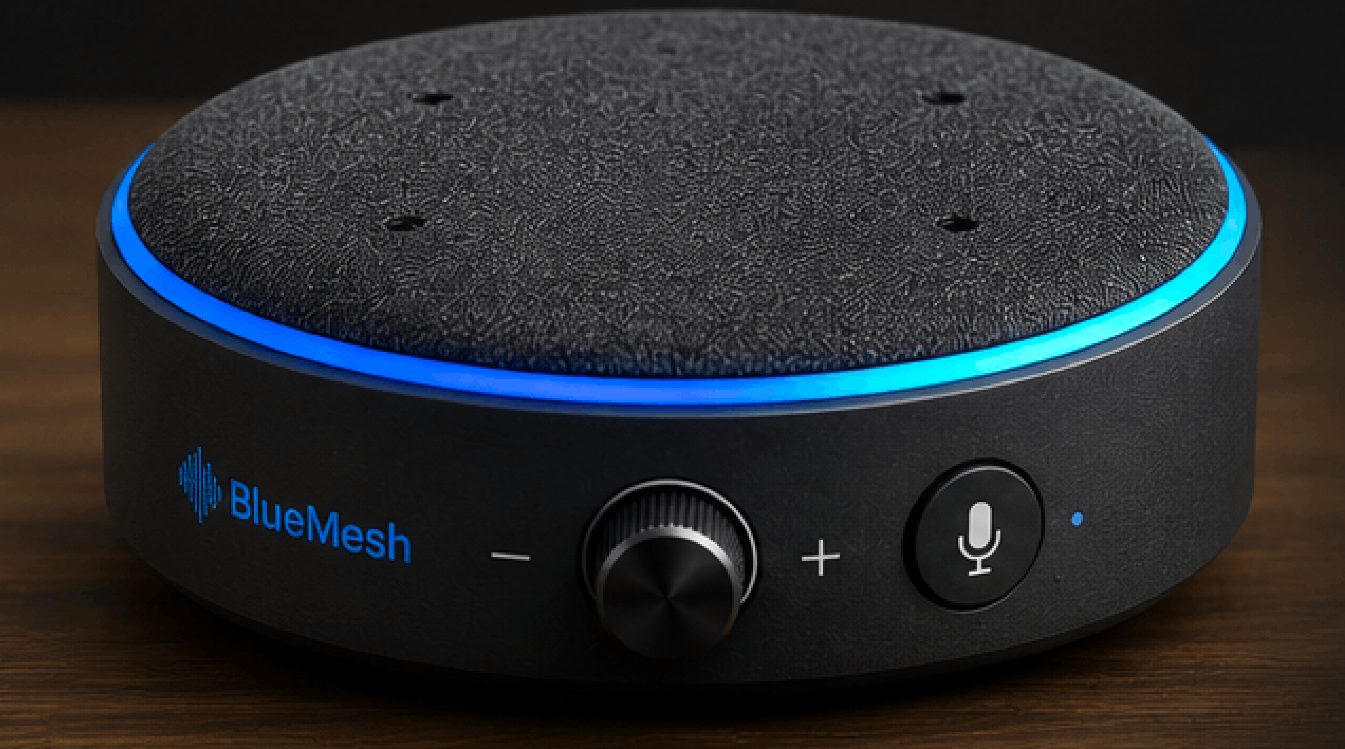
BM Device puts Blue Mesh in the room. Ask it a question the way you would ask a colleague, and it answers from your own systems and your own data, with no laptop, no dashboard and no login in between. It is built for the people who need the answer between two meetings.
A private platform stops being private at the microphone
Everything else about Blue Mesh is built so your data stays on infrastructure you control: private cloud, on premises, or fully air gapped. Put a shop-bought smart speaker in the room and that ends at the first question anybody asks out loud, because the room is now being listened to by a device that answers to somebody else. BM Device closes that gap. It is the microphone and the speaker for a platform you already run yourself, addressed on your own network, so the boundary you chose for the software also holds for the room.
You talk. It answers
There is nothing to install, nothing to log into and nothing to learn. The device is the interface.
Ask it the way you would ask a person
Plain speech, no command syntax, no wake-word gymnastics. Ask where an order is, what a number came to, whether something got approved.
It hears you from anywhere in the room
Four microphones listening in every direction, so it works from the far end of a boardroom table as well as a foot away.
The answer comes back out loud
Tuned for speech rather than music, because the job is to be understood the first time across a room. No screen to read, no phone to pick up.
Mute is a switch you can see
A physical switch, not a setting in an app. When it is off, it is off in hardware, and anyone in the room can see that. A different conversation with a security team.
It lives on your network, not someone else's
Wi-Fi 6 and Bluetooth, commissioned on your own infrastructure with open local firmware, not a vendor cloud account. Your IT team can inspect and manage it.
What you actually get by putting it in the room
BM Device is deployed with you, on your own network, as part of the Blue Mesh platform you already run. That is what makes the rest of this list possible.
- 01The answer comes from your systems, not from the internet. It is grounded in your own data, so it is about your business rather than about the world in general.
- 02It inherits everything the platform already does. The same audit trail, the same role-based access and the same approval gates apply to a question asked out loud as to one asked through a workflow.
- 03Nothing executes quietly. If a request would change something rather than just report it, it still stops for a person exactly where your policy says it must.
- 04It removes the step everyone skips. Most operational data goes unread because it lives behind a login and a dashboard. Asking is a lower bar than looking.
- 05It works for the people least likely to open a tool. The reader of this page is usually the person with the least time to learn one, and speech needs no training.
- 06One device, the whole platform. Voice agents, document and vision handling, translation and your private model layer are all already there behind it.
- Voice agents What the agent behind the device does when it takes a call rather than a question.
- Trust and control Deployment models, security controls and the human approval gate the device inherits.
- BM Studio Where the agents it answers with get built, in a conversation.
Bring a question you actually need answered
Tell us the operation and the systems it runs on, and we will show you BM Device answering a real question from your own data rather than a scripted one from ours.